Original PWO emblem
PWO
Philatelic Webmasters Organization
Original emblem of the Philatelic Webmasters Organization
2001 — 2026

25 Years of PWO

A Quarter-Century of Philately on the Internet

From the first generation of philatelic websites to international virtual exhibitions, PWO has encouraged collectors to share knowledge, defend philatelic integrity and give digital publishing a voice.

In 2001, creating a philatelic website was still a pioneering undertaking. Collectors were discovering that the Internet could do much more than advertise collections: it could preserve research, connect specialists across continents and make philatelic information available to anyone with a connection. The Philatelic Webmasters Organization (PWO) was established to encourage precisely that development. In 2026, it celebrates twenty-five years of work on behalf of philatelic webmasters and their readers.

A Quarter-Century at a Glance

2001PWO is founded to promote philately through philatelic webmastering.
2008PWO and AIJP present a joint philatelic webmastering initiative at EFIRO, Bucharest.
2022PWO-EXPO brings together 72 exhibits from 50 participants in 22 countries.
2026PWO marks its 25th anniversary and looks toward the next generation of philatelic publishing.

2001 · The founding idea

1. A Voice for Philatelic Webmasters

PWO was founded in 2001 by Victor Manta, a Swiss-based philatelist and webmaster. Its original statement of aims defined the mission plainly: to promote, support and develop philately through philatelic webmastering.

At a time when philatelic associations represented collectors, journalists and traditional publishers, a new kind of contributor was emerging: the collector who researched, wrote, illustrated, programmed and maintained a philatelic website. Such work combined philatelic knowledge with technical skills and often depended entirely on voluntary effort.

PWO sought to give those webmasters a common identity and to encourage cooperation rather than isolation. The underlying conviction was that publishing good philatelic information online benefits the entire hobby.

The founding text, Our Reasons and Goals, drew a careful distinction between philatelic webmasters and established professional groups. Journalists were represented by the International Association of Philatelic Journalists (AIJP), while publishers had their own associations. Philatelic webmasters formed a different community: collectors who combined knowledge of stamps and postal history with the skills needed to build and maintain a website.

The document emphasized that most such webmasters were amateurs, working from personal enthusiasm and a desire to share what they knew. PWO therefore began with a practical question: how could this emerging community cooperate, improve its publications and gain recognition within organized philately?

Read the original PWO reasons and goals

Original PWO emblem
The original PWO emblem, a familiar sign of international philatelic webmastering.

International membership

2. A Worldwide Community

The Internet offered philatelists something that printed publications could not always provide: the possibility of reaching readers around the world without waiting for the next issue of a journal or the next meeting of a society. PWO brought together the people who used that possibility to publish their research, collections and observations.

The organization grew into a network of hundreds of philatelic authors and website creators. A PWO–AIJP announcement in 2008 referred to more than 350 members. By 2022, a PWO account of the planned virtual exhibition reported more than 400 members representing over 415 sites. These figures document different moments in PWO's history; they should not be read as a statement of present-day membership.

There was never just one model of a PWO member's website. Some focused on the stamps or postal history of a particular country; others specialized in thematic collecting, exhibition material, research, illustrations or information for beginners. What united their authors was the belief that a carefully maintained website could make a genuine contribution to philatelic knowledge.

Such websites also crossed boundaries between collectors, editors and researchers. An article published by one webmaster could be discovered by a reader in another country, cited by a specialist or used as a starting point for new research. This international exchange was among the lasting promises of philatelic webmastering.

The members directory remains a visible record of that collective effort. Inevitably, the online world has changed: websites have moved, technologies have become obsolete and some early projects have disappeared. The historical value of the surviving links and documents has therefore grown with time.

Explore the PWO Members List

Philatelic integrity

3. Against Illegal Stamps: The UPU Circulars

One of PWO's most sustained activities has concerned illegal and abusive postage-stamp issues. These are not merely questions of taste or collecting fashion. Unauthorized products bearing the name of a country can be offered as genuine postal issues, confusing collectors and damaging confidence in the philatelic market. PWO's work has therefore combined documentation, public warning and critical discussion.

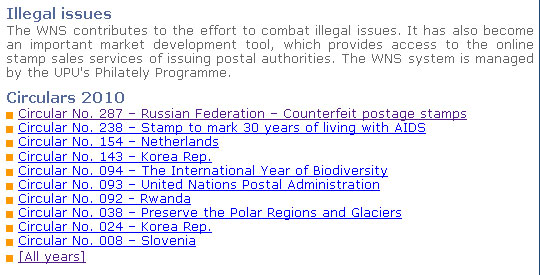
A particularly valuable resource is the archive of Universal Postal Union (UPU) circulars concerning illegal issues. Rather than leave the reader to search through scattered notices, PWO has organized the material by country. This makes it possible to trace warnings associated with a particular postal administration and to consult historical evidence alongside newer information.

The archive also preserves a chronological summary for 1996–2003, based on an eight-page historical document. Its own introduction warns that the list was never exhaustive: an absence from the summary cannot establish that a disputed item was legitimate. Such qualifications are essential to responsible philatelic research.

PWO's role has never been limited to reproducing official notices. Its articles have examined the strengths and weaknesses of tools intended to help collectors, including the WADP Numbering System (WNS). A 2017 analysis by Victor Manta questioned whether an incomplete registration database could reliably be used to infer that every unlisted stamp was illegal. The argument illustrates an important principle of the organization's work: official information should be made accessible, but it must also be examined critically.

For the collector, this distinction is practical. An official UPU circular is evidence of a communication from a postal administration; PWO's articles provide analysis and context. Neither should be confused with a blanket judgment about every item that resembles a stamp. The objective is better-informed collecting, not simply longer lists of prohibited material.

UPU Circulars — country index · Historical circulars, 1996–2003 · The WNS & UPU Circulars in 2017 · PWO articles on illegal stamps

Original image from PWO's UPU circulars archive
An original illustration from PWO's archive of UPU circulars concerning illegal issues.

Recognition and fair judging

4. International Website Competitions

From the early years of online philately, PWO followed competitions in which philatelic websites were presented alongside more established forms of literature. The organization recorded results and experiences, including recognition received by PWO and its members.

At the same time, PWO argued that a website cannot be judged simply as if it were a printed book. Its usefulness also depends on navigation, links, updating, accessibility and the ways in which readers can explore information. These features are not secondary technical details; they are part of the publication itself.

The organization's historical competition reports discuss the practical consequences of exhibition rules, participation fees and judging arrangements. Such criticism has a constructive purpose: to make digital competition more transparent, more welcoming and more relevant to the medium.

A revealing example appears in PWO's discussion of the FIP Literature Commission's 2005 article, The Role of Websites in Philatelic Literature Competitions. The debate was not merely about medals. It concerned the basic definition of a philatelic website as an exhibit: how should a jury evaluate navigation, links, continuous revision and the combination of research with presentation?

PWO argued that digital publications deserved criteria appropriate to their medium. Its published responses are also a record of the sometimes difficult dialogue between pioneering web authors and established exhibition institutions. They should be read as PWO's documented position in that debate, not as a neutral account of every participant's view.

Historical website competition reports · PWO on competitions

Historical award image from the PWO archive, 2002
Historical PWO award illustration preserved in the site's 2002 archive.

Bucharest · 2008

5. EFIRO 2008: Philatelic Websites Enter the Exhibition Hall

The international philatelic exhibition EFIRO 2008 in Bucharest offered PWO a particularly meaningful opportunity to demonstrate the value of philatelic publishing on the Internet. The exhibition commemorated the 150th anniversary of Romania’s first postage stamps, the celebrated Moldavian Bull Heads.

The idea was to present selected web pages devoted to Romanian philately to visitors of a major international exhibition. PWO proposed and coordinated the initiative in cooperation with the Association Internationale des Journalistes Philatéliques (AIJP) and the exhibition organizers. It connected the work of online authors with the established world of philatelic exhibitions and journalism.

According to the original PWO–AIJP announcement, the EFIRO organizing committee approved the project in April 2007. In May 2007, representatives of the organizing committee and PWO met in Bern, at the International Bureau of the Universal Postal Union, to discuss the project's objectives and practical arrangements.

The resulting presentation featured philatelic material from 11 webmasters representing several countries: Claude Wainstein, Dan Dobrescu, Dan Grecu, Fery Ambrus, Horst Scherer, Jay Carrigan, Laszlo Kallai, Mats Blückert, Paul Hirsch, Valentin Robu and Victor Manta. Their pages illustrated how the Internet could bring together diverse approaches to Romanian stamps and postal history.

EFIRO 2008 was therefore more than an occasion to display websites. It was an early example of cooperation between a community of philatelic webmasters, an international association of philatelic journalists and the organizers of a major exhibition. It made visible an idea central to PWO since its foundation: online philatelic research deserves a place within the wider philatelic culture.

Original PWO–AIJP press release · Introduction to the exhibition pages · The 11 participating webmasters

Original EFIRO 2008 exhibition poster from PWO archive
The EFIRO 2008 poster, preserved in the PWO archive.

2022 · From principles to practice

6. PWO-EXPO 2022: An Exhibition Designed for the Web

After years of discussing the place of websites in international philatelic competitions, PWO helped put its ideas into practice through PWO-EXPO 2022, an open virtual exhibition for philatelic websites and social media, organized in cooperation with Virtuafil.

According to the organizers’ closing message, registration closed on 9 July 2022 and the exhibition concluded on 19 September 2022. The original closing report records these figures and the jury’s award decisions; it remains available in the modernized PWO archive.

The organizers sought to remove some of the barriers associated with conventional exhibitions and to recognize online publishing on its own terms. The competition brought together websites and social-media exhibits from across the world, with jury evaluation and public participation.

72exhibits
50participants
22countries

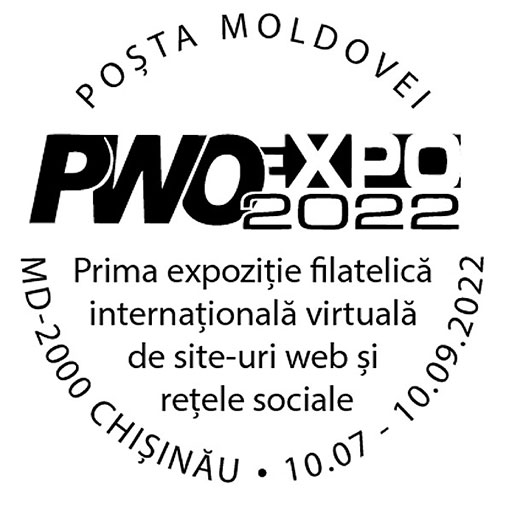
These figures are recorded in PWO's contemporary reports. The exhibition also received a special commemorative cancellation issued by Moldova Post. Its closing report recorded 12 Gold, 12 Silver and 21 Bronze medals, and acknowledged the volunteer international jury.

Commemorative Moldova Post cancellation for PWO-EXPO 2022
Special Moldova Post cancellation dedicated to PWO-EXPO 2022.
Gold award document from PWO-EXPO 2022
An original award illustration from the PWO-EXPO 2022 archive.

PWO-EXPO was significant not only for its results but for what it demonstrated: an international philatelic exhibition could be organized around the actual characteristics of digital publications, rather than forcing them into a format inherited from print.

Founding statement and participation rules · Exhibition report · Closing message and results (modernized test page)

2001–2026

7. Twenty-Five Years Later: The Mission Continues

In 2001, a philatelic webmaster needed patience, curiosity and a willingness to learn new technical skills. In 2026, publishing tools are far more accessible, readers increasingly use mobile devices and automatic translation helps overcome language barriers. But technology alone does not make a valuable philatelic publication.

Good philatelic work still rests on the same foundations: reliable evidence, accurate identification, clear illustrations, responsible interpretation and the readiness to correct mistakes. These are the qualities that make a website worth returning to, and worth preserving.

PWO's own archive tells a second story, about the history of the Internet itself. Early websites were often personal initiatives sustained for years by unpaid effort. Some have disappeared; others survive only because their creators continued to care for them. Preserving competition records, official documents, reports and the debates surrounding online publishing is consequently a form of historical stewardship.

Looking ahead, PWO's founding questions remain relevant. How can trustworthy philatelic information be found amid a growing volume of online material? How should digital publications be evaluated fairly? And how can collectors of different generations and languages continue to learn from one another? The answers will evolve, but the need for an independent, internationally minded philatelic community remains.

The first quarter-century of PWO is an occasion to thank the philatelic webmasters who have contributed their time, knowledge and enthusiasm. It is also an invitation to a new generation to continue publishing, questioning, sharing and exploring.

Twenty-five years of PWO celebrate not only an organization, but the philatelists who believed that the Internet could open new horizons for stamp collecting.

Philatelic Webmasters Organization — Promoting Philately on the Internet since 2001.

Historical Sources and Notes

The references below are original PWO publications and historical records. Membership figures describe the years in which they were reported, not the current membership. Competition figures follow the organizers’ published results.

  1. Our Reasons and Goals — PWO’s founding principles and objectives.
  2. PWO–AIJP–EFIRO 2008 press release — The webmastering initiative and historical membership figures.
  3. EFIRO 2008 participants — Original list of eleven participating webmasters.
  4. UPU circulars, 1996–2003 — Historical summary; not an exhaustive inventory.
  5. Can the FIP Judge the Philatelic Websites? — PWO’s published perspective on website judging.
  6. About PWO-EXPO 2022 — Background to the virtual exhibition and contemporary membership figures.
  7. PWO-EXPO 2022 — Closing Message and Comments — Exhibition participation, jury, awards and closing remarks.

About PWO · Return to the homepage